Privacy Law and Corporate Screen Security Obligations

Many organizations that receive penalties for data protection violations did not intentionally leak information. They are sanctioned for failing to implement the technical measures required to prevent personal data displayed on screens from being seen by unauthorized individuals. The law demands more than outcomes — it scrutinizes process, and screen security is part of that process.
TL;DR
- Data protection regulations explicitly require technical and administrative measures to prevent unauthorized viewing of personal data displayed on screens.
- Finance, healthcare, and public sector organizations must meet sector-specific requirements that go beyond the baseline law, with more detailed screen security obligations.
- Compliance is not just about avoiding fines — it means building a practical security framework that genuinely prevents exposure incidents.
What Data Protection Law Actually Requires for Screen Security
Korea's Personal Information Protection Act (PIPA) imposes a duty on personal information processors to implement technical and administrative safeguards for the secure handling of personal data. This duty applies not only to storage and transmission, but equally to the moment personal data is displayed on screen and actively processed.
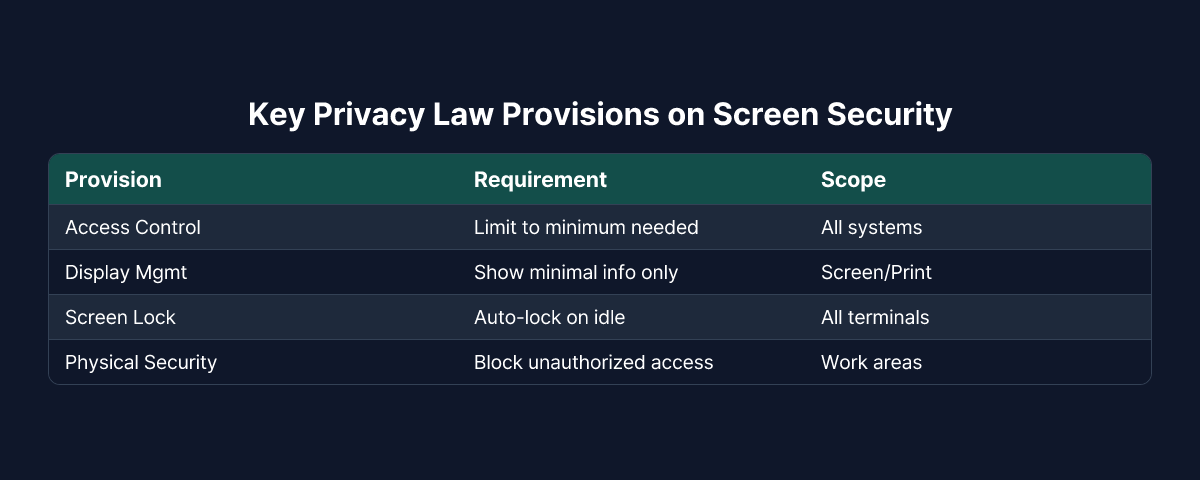
Specifically, the PIPA Enforcement Decree Article 29 and the Standards for Ensuring the Safety of Personal Information (Ministry Notification) require the following.
- Access control: Restrict access rights to personal data processing systems to the minimum necessary for performing job duties
- Output and copy management: Limit what personal data is displayed on screen, or restrict the scope of displayed information when output is necessary
- Screen protection: Activate a screen lock or saver after a defined period of inactivity
These provisions require organizations to establish both physical and technical environments that prevent personal data shown on screen from being exposed to unauthorized parties. This goes beyond managing system login credentials.
Sector-Specific Requirements: Finance, Healthcare, and Public Sector
PIPA applies to all personal information processors as baseline legislation, but specific industries face additional regulatory requirements. The following sectors deserve particular attention for screen security compliance.
Finance
Financial companies are subject not only to PIPA but also to the Electronic Financial Supervision Regulations, the Financial Consumer Protection Act, and the Financial Supervisory Service's IT inspection manual. The FSS requires that when customer account details, credit information, or transaction records appear on screen, access must be limited to those with the appropriate business authorization, with controls preventing unauthorized individuals from viewing the display. These requirements apply with particular strictness in branch teller environments where multiple customers' information appears simultaneously.
Healthcare
Medical institutions must comply with the Medical Service Act, the Medical Devices Act, and the Ministry of Health and Welfare's healthcare information protection guidelines. Patient records, test results, and prescription information must be accessible only to the medical personnel directly involved in that patient's care. Because healthcare settings frequently include shared monitors, inquiry terminals, and front-desk counters accessible to multiple people, screen security must operate in combination with physical environment controls.
Public Sector
Public institutions are subject to PIPA alongside the Ministry of the Interior and Safety's Guidelines on Personal Information Protection for Public Institutions and national information security directives. Systems that process sensitive data — resident registration numbers, health information, income records — are required to apply masking to on-screen displays and maintain access logs. These standards apply equally when employees access systems while working remotely or traveling.
What Happens When Screen Security Obligations Are Violated
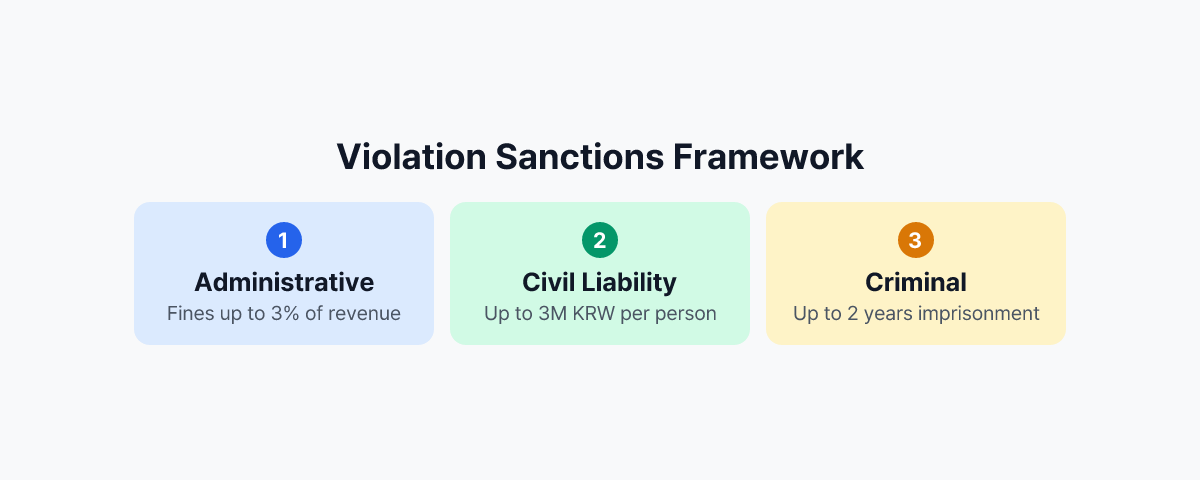
When a personal data breach occurs and the organization has not implemented the required technical safeguards, multiple types of sanctions can follow simultaneously.
For administrative sanctions, the Personal Information Protection Commission can issue corrective orders, administrative fines (up to KRW 30 million), and penalty surcharges (up to 3% of relevant revenue). The 2023 amendments to PIPA strengthened the penalty surcharge calculation criteria, raising the practical level of financial exposure.
For civil liability, affected data subjects may file claims for damages. If the organization cannot prove the absence of negligence, courts may award statutory damages of up to KRW 3 million per person.
For criminal liability, intentional violation of safety measure obligations or negligent disclosure of personal data can result in imprisonment of up to two years or a fine of up to KRW 20 million.
The core principle is that regulators examine whether reasonable preventive measures were in place before determining whether a breach occurred.
Practical Screen Security Measures Organizations Must Implement
Translating legal requirements into operational practice involves three categories of screen security measures.
Technical measures begin with screen lock policies on personal data processing systems — automatic locking after a defined idle period. Environments where customer information is continuously accessed, such as call centers, bank branches, and hospital registration desks, require masking of personal data fields (partial concealment of resident registration numbers, etc.). Beyond these baseline measures, technical controls that detect physical attempts to photograph on-screen information using smartphones or cameras now fall within the scope of required safeguards.
Administrative measures include annual training for employees who handle personal data, documentation of screen security policies, and restrictions on cameras and smartphones in areas where personal data is processed. The same standards must apply when contractors or dispatched workers access personal data systems.
Physical measures include positioning personal data terminals so screens are not visible to outsiders, designating restricted security zones within offices, and enforcing screen locks when workstations are unattended.
Addressing Screen Security Compliance with MonitorDog
Among the required technical measures, one area remains uncovered by conventional solutions: direct smartphone photography of on-screen information. Screenshot blocking and network DLP prevent leaks through digital pathways — but photographing a screen with a physical camera leaves no trace in any log.
MonitorDog addresses this blind spot directly. By analyzing the environment around the screen in real time through the PC's webcam, the AI detects smartphone photographing attempts and abnormal access behavior, then delivers instant alerts and event records to administrators. The captured images and logs from each detected incident serve as audit evidence, providing documented proof of technical safeguard implementation.
The scope of what constitutes "reasonable technical safeguards" under data protection law continues to evolve as the threat landscape changes. Now that physical screen photography has become a real and documented threat vector, technical controls covering this area are increasingly becoming items on the compliance checklist.
To see how MonitorDog handles screen security compliance in practice, request a free demo and experience the detection process firsthand.
References
- Personal Information Protection Commission, "Standards for Ensuring the Safety of Personal Information" (Notification No. 2023-6)
- Personal Information Protection Commission, "Commentary on the Personal Information Protection Act" (2023)
- Financial Supervisory Service, "Financial Company IT Inspection Manual" (2022)
- Ministry of the Interior and Safety, "Guidelines on Personal Information Protection for Public Institutions" (2024)