Insider Threat Prevention Checklist for CISOs

Security incidents are not the exclusive domain of outside attackers. According to research by IBM and the Ponemon Institute, the average cost of an insider-related incident exceeds $16 million per event — and more than half of all insider incidents stem from simple negligence rather than malicious intent. For CISOs, insider threats remain one of the most difficult challenges to address: too strict and you stifle productivity, too lenient and exposure can happen anywhere without warning.
TL;DR
- Insider threats fall into three categories — malicious, negligent, and compromised — each requiring different controls.
- Access governance, behavioral monitoring, screen security, and incident response procedures must work as a connected system.
- Technical controls alone are insufficient; security awareness training and culture building are essential for sustained risk reduction.
Start by Understanding Insider Threat Types
Before building a response checklist, you need clarity on what you are defending against. Insider threats are not a single phenomenon. They break into three distinct categories.
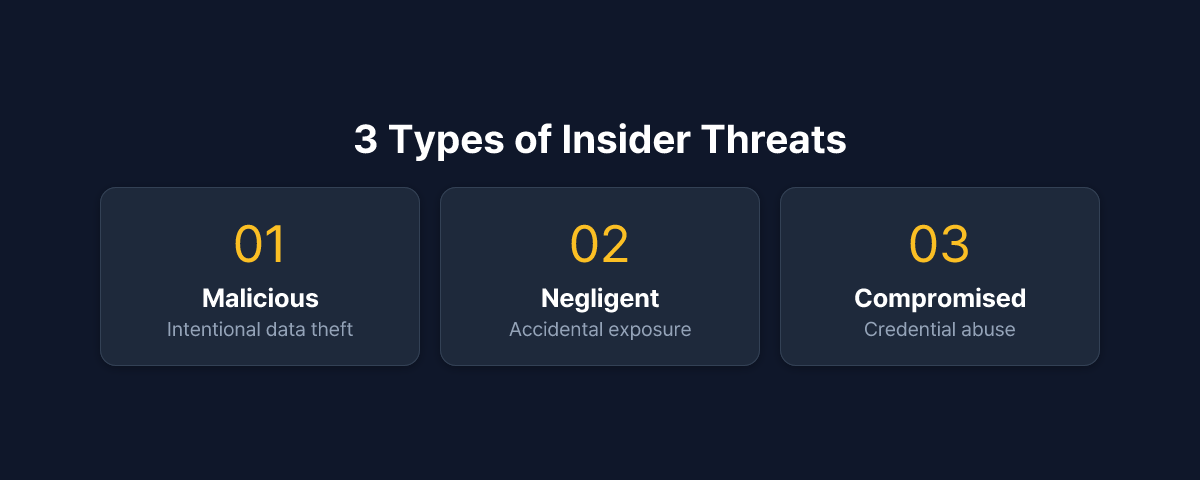
Malicious insiders act with intent — exfiltrating data for financial gain, taking intellectual property before leaving for a competitor, or acting on personal grievances. These cases are difficult to detect but leave behavioral signals: unusual access patterns, bulk downloads before a resignation notice, and atypical working hours.
Negligent insiders do not intend harm, but their habits create exposure. Misdirected emails, misconfigured cloud sharing, unattended unlocked screens — these account for the majority of insider incidents. Technology controls help, but they cannot eliminate the risk entirely because the root cause is human behavior.
Compromised insiders are employees whose credentials have been hijacked through phishing, social engineering, or supply chain attacks. From the system's perspective, a legitimate account is operating, but the person at the controls is effectively an external threat actor. This category demands strong authentication alongside behavioral monitoring.
All three types share one common thread: they exploit access. That is why this checklist is organized around the question of who can access what, and whether that access is being used appropriately.
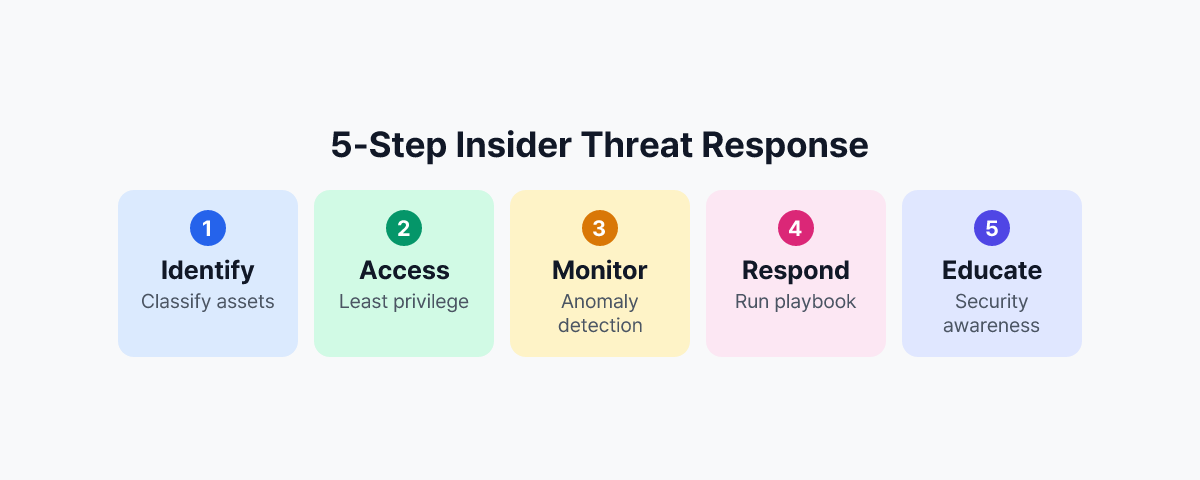
Checklist 1. Information Asset Identification and Classification
You cannot protect what you have not defined. The first step in any insider threat prevention program is knowing exactly what needs protecting.
- Is an inventory of sensitive information assets maintained and kept current?
- Is data classified by sensitivity level (e.g., Confidential, Internal, Public)?
- Are permitted handling methods (storage, transmission, printing) defined for each classification level?
- Are the systems and formats in which critical assets exist reviewed on a regular cycle?
- Are cloud storage environments audited for unclassified or improperly shared files?
Without an asset inventory, you cannot determine where a leak occurred. Without a classification framework, you cannot set rational control priorities.
Checklist 2. Access Control and Privilege Management
The blast radius of any insider threat is bounded by the access that person holds. Reducing unnecessary access is the most direct lever available.
- Is the Principle of Least Privilege applied consistently across all systems?
- Does role-based access control (RBAC) accurately reflect current job responsibilities?
- Is there a process to revoke access on the same day or within one business day for departures and role changes?
- Are dormant accounts and unused privileges reviewed and removed on a regular schedule?
- Is activity for privileged accounts (administrators, DBAs) logged and reviewed separately?
- Is multi-factor authentication (MFA) required for access to sensitive systems?
- Is contractor and third-party access scoped to the duration and scope of the engagement?
Quarterly access reviews alone — simply auditing who has what — can eliminate a significant number of accumulated unnecessary access paths.
Checklist 3. Behavioral Monitoring and Anomaly Detection
Even with correctly scoped access, monitoring how that access is used in practice remains essential.
- Are access logs from critical systems collected centrally and retained?
- Are alerts configured for anomalous patterns: after-hours access, bulk file downloads, sudden spikes in external transfers?
- Does the DLP solution cover the primary data egress paths: email, USB, cloud upload?
- Are print history and screen capture activity recorded?
- Is a screen security solution in place to detect physical exfiltration attempts, such as photographing a monitor with a smartphone?
- Is monitoring data collected and processed in compliance with applicable privacy regulations?
The screen security item warrants specific attention. DLP controls digital and network-based exfiltration, but photographing a monitor with a nearby smartphone bypasses every DLP control — no network traffic, no file transfer, no detectable event. MonitorDog uses the employee's PC webcam to detect these physical capture attempts in real time using AI, generating immediate alerts and an event record for administrators. This addresses the gap that conventional DLP infrastructure cannot reach.
Checklist 4. Incident Response and Forensic Readiness
Prevention controls reduce risk, but no control set eliminates it entirely. The ability to detect a breach quickly and respond effectively determines how much damage is contained.
- Is an insider threat incident response playbook documented and accessible?
- Are the reporting lines to HR, Legal, and executive leadership clearly defined for security incidents?
- Are logs retained for a sufficient period (minimum one year) in a tamper-resistant manner?
- Are immediate response procedures (account suspension, system isolation) defined and practiced?
- Is a chain of custody process maintained so that evidence remains admissible in legal proceedings?
- Is a tabletop exercise or incident simulation conducted at least once per year?
Organizations frequently find, after an incident, that the logs they need no longer exist — either past retention limits or never collected in the right format. Forensic readiness is built before the incident, not during it.
Checklist 5. Security Awareness and Organizational Culture
Technical controls block known vectors. But a significant share of insider risk originates in moments when an employee does not recognize a threat, or chooses convenience over compliance. Culture is the only control that scales across every person, every device, and every situation.
- Is organization-wide security awareness training delivered at least annually?
- Are phishing simulation exercises run regularly, with results tracked by department?
- Do employees who handle sensitive data (HR, Finance, R&D) receive role-specific training beyond the baseline?
- Are anonymized policy violation cases shared internally as learning opportunities?
- Is there an internal channel — including an anonymous option — for reporting security concerns?
- Does the new hire onboarding process include information security policy training?
The most effective awareness training moves beyond abstract warnings. Concrete scenarios — "here is what happened, here is what the person did, here is what it cost" — drive behavioral change far more reliably than policy reminders.
Closing Thought: The Checklist Is a Starting Point
A perfect score on this checklist does not eliminate insider risk. What it does is give you a clear picture of where your current program is weakest and what to address first.
For organizations beginning their first structured review, starting with an access privilege audit and a DLP coverage assessment is a practical entry point. For organizations with mature baseline controls, the next step is addressing gaps that existing DLP infrastructure does not cover — physical screen exposure being one of the most commonly overlooked.
Insider threat prevention is not a one-time project. It is a continuous cycle of assessment, improvement, and adaptation.
To see how MonitorDog addresses the blind spots that conventional DLP leaves open, request a free demo and walk through the detection process in a real environment.
References
- Ponemon Institute & DTEX Systems, "2025 Cost of Insider Risks Global Report" (2025)
- CISA, "Insider Threat Mitigation Guide" (2020)
- Personal Information Protection Commission (Korea), "Standards for Ensuring Safety of Personal Information" (2023)